By Dr. Scott P. Sells, Ph.D. | Author, Parenting Your Out-of-Control Teenager

“Be responsible.”
“Help out more.”
“Stop making everything so difficult.”
You may know exactly what you mean. Your teenager may hear a complaint without knowing what action would satisfy it.
Setting boundaries with teenagers starts with a clear plan made before the next conflict. Choose one observable expectation, explain the reason, listen for obstacles, and decide what you can realistically follow through on. When a teenager refuses to follow rules, adding more rules at once usually makes the plan harder to manage.
Start With One Behavior You Can Describe
Choose a recurring issue that matters and can be addressed safely. Trying to fix chores, grades, tone of voice, bedtime, and phone use in one family conversation tends to produce a long list nobody follows.
Instead of “Help around here,” try: “On school nights, put your dinner dishes in the dishwasher before you start your evening entertainment.”
That is a hypothetical household rule, not a prescription for every family. Adapt it to your teen’s abilities, schedule, and needs. Ask whether they understand the task and whether there is a practical obstacle you have missed.
A boundary also needs a realistic adult action. You can decide when you provide an optional ride or authorize a purchase. You cannot guarantee that your teenager will feel cooperative about it.
Separate Preferences From Safety Limits
Some details have room for negotiation. Your teen might prefer to do a chore before dinner or set a reminder on their phone. Letting them help choose the method can make the arrangement more workable.
Safety concerns need a different conversation. A rule about confirming transport arrangements carries more weight than a disagreement about bedroom decor. Explain the actual risk instead of describing every preference as a safety issue, or the word “safety” stops meaning much.
Do not make access to food, shelter, medical care, or help in an emergency conditional on following a rule.
Get Caregivers Clear on the Same Plan
Where possible, agree privately on the expectation and the response before presenting it. Decide who will follow up and how exceptions will be handled. Your teen should not have to interpret two different answers in the same evening.
If households have different rules, explain what applies in yours without asking your teen to referee the adults.
You might introduce the plan this way: “We’ve been arguing about this every night. We want a clearer agreement. Here is the job that needs doing. What would help you remember it?”
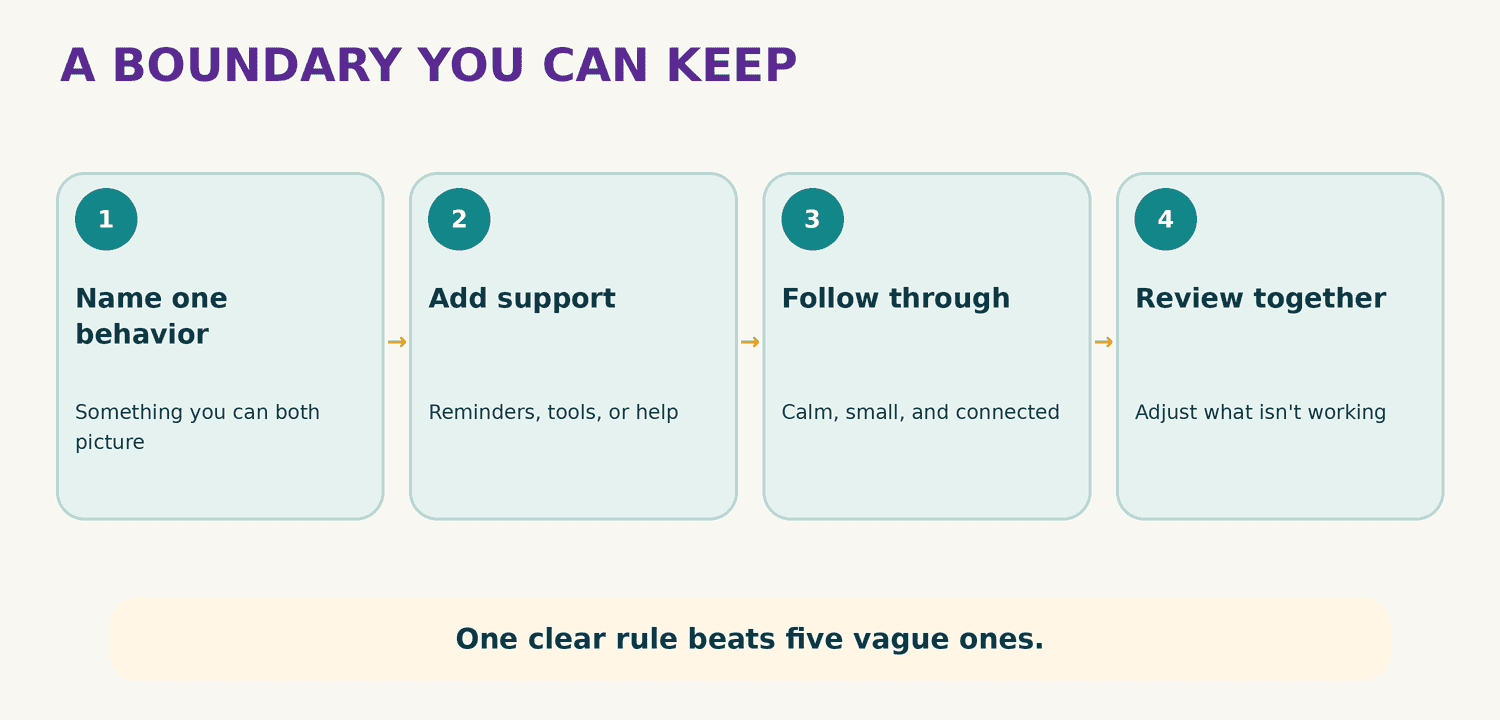
A boundary you can keep: name one behavior, add support, follow through calmly, and review the plan together.
Write a Boundary Plan You Can Actually Use
Copy and complete this example together:
Expectation: On __________, I will __________ by __________.
Reason: This matters because __________.
Support: The reminder, equipment, or help available is __________.
Choices: My teen can choose __________.
Adult follow-through: If the expectation is missed, we will __________.
Path back: The next opportunity to meet the expectation or regain the optional privilege is __________.
Exceptions: If __________ happens, contact __________ so we can adjust the plan.
Review: We will check whether this is working on __________.
Keep the response proportionate and connected to the issue. In the dishes example, a family might agree that an optional parent-funded movie rental waits until the dishes are put away. Once the task is done, the rental goes ahead. No extra week of punishment gets added during an argument.
If following through repeatedly triggers aggression, get help adapting the plan rather than trying to enforce it through confrontation.
Worked Examples: From Vague Rule to Working Plan
These hypothetical families show what the plan can look like in practice, including the parts that don’t go smoothly.
The Laundry That Never Moves
Fifteen-year-old Marcus leaves wet laundry in the washer for days. His parents have said “deal with your laundry” many times.
The new expectation: “When you start a load, move it to the dryer the same evening. If you can’t, text me before you leave so I can move it.”
Support: Marcus sets a phone timer when he starts the washer.
Follow-through: If a load sits overnight, the next load waits until the washer is clear and Marcus has moved it.
In the first week, Marcus moves the laundry twice and forgets once. At the review, his parent starts with what worked: “You moved it on Monday and Thursday without a reminder.” Then they look at the miss. Marcus started that load right before soccer practice. The plan gets one adjustment: no loads on practice nights.
The Curfew That Keeps Slipping
Seventeen-year-old Elena has been coming home 20 to 40 minutes late on weekends.
The parents had been saying “be home at a reasonable time.” Elena’s version of reasonable and theirs did not match. The new plan sets 11 p.m., with a call before 10:45 if anything changes, and a 10 p.m. return for the following weekend if she is late without calling.
The first weekend, Elena calls at 10:40 because her ride is leaving later than planned. The parent arranges a pickup instead of treating the call as a violation. That matters. If calling ahead gets punished the same way as coming home late, Elena has little reason to call next time.
The Gaming That Swallows Homework
Thirteen-year-old Theo says he’ll do homework after “one more game,” and the evening disappears.
The parent first checks whether homework itself is the obstacle. It turns out Theo is behind in science and doesn’t understand the current unit. The plan becomes two parts: homework before gaming on school nights, and a weekly check-in with the science teacher that the parent helps set up.
This is a common pattern. A rule that keeps getting broken sometimes points to a skill gap, a schedule conflict, or a worry the teen hasn’t mentioned. Checking costs one conversation.
Turn a Vague Rule Into a Usable Agreement
A household rule becomes easier to discuss when everyone can describe what meeting it looks like. These examples are starting points, not universal rules.
| Vague instruction | Observable expectation | Support and review |
|---|---|---|
| “Help around the house.” | Put dinner dishes in the dishwasher before evening entertainment | Agree on one reminder; review after one week |
| “Keep us informed.” | Share the destination and ride plan before an outing | One agreed message format; discuss exceptions |
| “Be ready on time.” | School bag and shoes by the door at the agreed departure time | Make a checklist together; look at what caused delays |
| “Stop spending so much.” | Ask before purchases on the family account | Explain the limit and how to request an exception |
| “Take care of your things.” | Move laundry to the dryer the same evening it’s washed | Phone timer; skip loads on practice nights |
| “Get your homework done.” | Homework finished before gaming on school nights | Check for skill gaps; weekly teacher check-in if needed |
How to Handle the Next Conversation
The review conversation decides whether a boundary turns into a working agreement or another source of friction.
Bring the Written Plan
Have the plan in front of you so you are both discussing the same expectation, not two different memories of it.
Start With What Happened
Describe facts before judgments: “The dishes were put away on three school nights. On the other two, they were still on the table.” Avoid opening with “You still aren’t taking this seriously.”
Ask What Was Different on the Missed Days
Try: “What was going on Tuesday and Thursday?” Perhaps an after-school activity changed the routine, or the reminder came at a bad moment. Perhaps your teen simply didn’t want to do it. Each explanation leads to a different adjustment, and none requires a speech about every past problem.
Review Your Own Part
Caregivers can say: “We agreed to give one reminder, and we kept repeating it. We’ll work on that.” Your teen is more likely to engage with the review if it isn’t only about them.
If Your Teen Won’t Engage
A shrug or “I don’t know” is common. Keep the review short: “Here’s what I noticed. Here’s the one change I’m suggesting. If you think of something better, tell me by Sunday.” You can still make a reasonable decision without full participation.
Decide and Write It Down
End by recording any change and the next review date. If the plan was followed, say so specifically and let that acknowledgment stand. Resist moving immediately to a harder requirement. A boundary your teen has just started meeting needs time to become routine.
Frequently Asked Questions
What If My Teen Won’t Agree to the Rule?
You can hear their objections and still state a reasonable household expectation. A signature is not a substitute for clarity. Explain what you will do, offer practical support, and leave room to review problems.
Does Consistency Mean Never Making Exceptions?
No. Illness, changed schedules, or a task your teen can’t currently manage may require adjustment. Explain the exception and when the usual arrangement resumes.
What If Nothing Changes?
Check understanding, ability, reminders, and adult follow-through. Persistent conflict affecting daily life deserves professional support. The Royal Children’s Hospital’s guide to teen behavior can help you recognize when to seek it.
One Thing to Try Tonight
Replace one vague complaint with an action your teen can picture. Discuss it during a quiet moment, then fill in the review date together.
Explore Extreme Teen’s Free Tools for support with that conversation. The book page offers more background on Dr. Scott’s work.