By Dr. Scott P. Sells, Ph.D. | Author, Parenting Your Out-of-Control Teenager

How to Set Boundaries With a Teenager Who Refuses to Follow Rules

“Be responsible.”

“Help out more.”

“Stop making everything so difficult.”

You may know exactly what you mean. Your teenager may hear a complaint without knowing what action would satisfy it.

Setting boundaries with teenagers starts with a clear plan made before the next conflict. Choose one observable expectation, explain the reason, listen for obstacles, and decide what you can realistically follow through on. When a teenager refuses to follow rules, adding more rules at once usually makes the plan harder to manage.

Start With One Behavior You Can Describe

Choose a recurring issue that matters and can be addressed safely. Trying to fix chores, grades, tone of voice, bedtime, and phone use in one family conversation tends to produce a long list nobody follows.

Instead of “Help around here,” try: “On school nights, put your dinner dishes in the dishwasher before you start your evening entertainment.”

That is a hypothetical household rule, not a prescription for every family. Adapt it to your teen’s abilities, schedule, and needs. Ask whether they understand the task and whether there is a practical obstacle you have missed.

A boundary also needs a realistic adult action. You can decide when you provide an optional ride or authorize a purchase. You cannot guarantee that your teenager will feel cooperative about it.

Separate Preferences From Safety Limits

Some details have room for negotiation. Your teen might prefer to do a chore before dinner or set a reminder on their phone. Letting them help choose the method can make the arrangement more workable.

Safety concerns need a different conversation. A rule about confirming transport arrangements carries more weight than a disagreement about bedroom decor. Explain the actual risk instead of describing every preference as a safety issue, or the word “safety” stops meaning much.

Do not make access to food, shelter, medical care, or help in an emergency conditional on following a rule.

Get Caregivers Clear on the Same Plan

Where possible, agree privately on the expectation and the response before presenting it. Decide who will follow up and how exceptions will be handled. Your teen should not have to interpret two different answers in the same evening.

If households have different rules, explain what applies in yours without asking your teen to referee the adults.

You might introduce the plan this way: “We’ve been arguing about this every night. We want a clearer agreement. Here is the job that needs doing. What would help you remember it?”
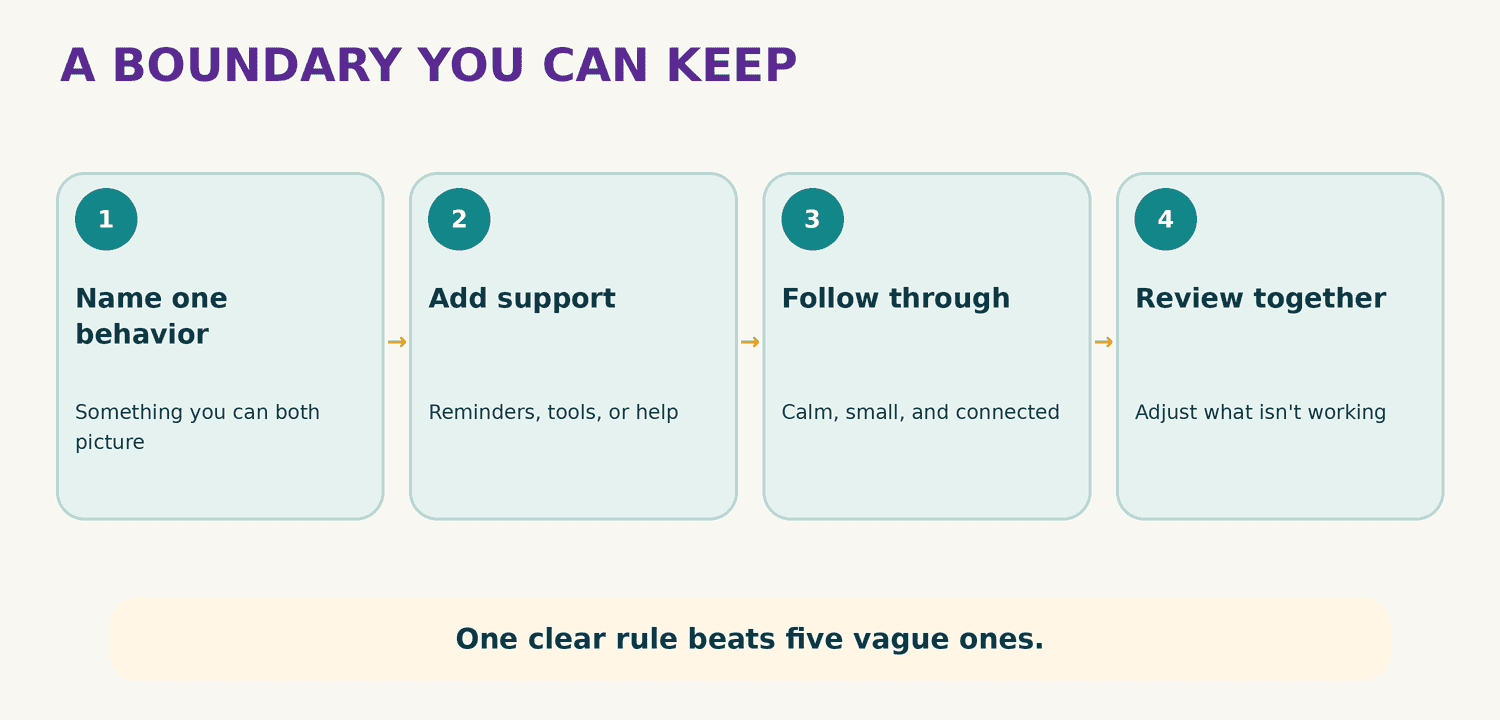
A boundary you can keep: name one behavior, add support, follow through calmly, and review the plan together.

Write a Boundary Plan You Can Actually Use

Copy and complete this example together:

Expectation: On __________, I will __________ by __________.

Reason: This matters because __________.

Support: The reminder, equipment, or help available is __________.

Choices: My teen can choose __________.

Adult follow-through: If the expectation is missed, we will __________.

Path back: The next opportunity to meet the expectation or regain the optional privilege is __________.

Exceptions: If __________ happens, contact __________ so we can adjust the plan.

Review: We will check whether this is working on __________.

Keep the response proportionate and connected to the issue. In the dishes example, a family might agree that an optional parent-funded movie rental waits until the dishes are put away. Once the task is done, the rental goes ahead. No extra week of punishment gets added during an argument.

If following through repeatedly triggers aggression, get help adapting the plan rather than trying to enforce it through confrontation.

Worked Examples: From Vague Rule to Working Plan

These hypothetical families show what the plan can look like in practice, including the parts that don’t go smoothly.

The Laundry That Never Moves

Fifteen-year-old Marcus leaves wet laundry in the washer for days. His parents have said “deal with your laundry” many times.

The new expectation: “When you start a load, move it to the dryer the same evening. If you can’t, text me before you leave so I can move it.”

Support: Marcus sets a phone timer when he starts the washer.

Follow-through: If a load sits overnight, the next load waits until the washer is clear and Marcus has moved it.

In the first week, Marcus moves the laundry twice and forgets once. At the review, his parent starts with what worked: “You moved it on Monday and Thursday without a reminder.” Then they look at the miss. Marcus started that load right before soccer practice. The plan gets one adjustment: no loads on practice nights.

The Curfew That Keeps Slipping

Seventeen-year-old Elena has been coming home 20 to 40 minutes late on weekends.

The parents had been saying “be home at a reasonable time.” Elena’s version of reasonable and theirs did not match. The new plan sets 11 p.m., with a call before 10:45 if anything changes, and a 10 p.m. return for the following weekend if she is late without calling.

The first weekend, Elena calls at 10:40 because her ride is leaving later than planned. The parent arranges a pickup instead of treating the call as a violation. That matters. If calling ahead gets punished the same way as coming home late, Elena has little reason to call next time.

The Gaming That Swallows Homework

Thirteen-year-old Theo says he’ll do homework after “one more game,” and the evening disappears.

The parent first checks whether homework itself is the obstacle. It turns out Theo is behind in science and doesn’t understand the current unit. The plan becomes two parts: homework before gaming on school nights, and a weekly check-in with the science teacher that the parent helps set up.

This is a common pattern. A rule that keeps getting broken sometimes points to a skill gap, a schedule conflict, or a worry the teen hasn’t mentioned. Checking costs one conversation.

Turn a Vague Rule Into a Usable Agreement

A household rule becomes easier to discuss when everyone can describe what meeting it looks like. These examples are starting points, not universal rules.

Vague instructionObservable expectationSupport and review
“Help around the house.”Put dinner dishes in the dishwasher before evening entertainmentAgree on one reminder; review after one week
“Keep us informed.”Share the destination and ride plan before an outingOne agreed message format; discuss exceptions
“Be ready on time.”School bag and shoes by the door at the agreed departure timeMake a checklist together; look at what caused delays
“Stop spending so much.”Ask before purchases on the family accountExplain the limit and how to request an exception
“Take care of your things.”Move laundry to the dryer the same evening it’s washedPhone timer; skip loads on practice nights
“Get your homework done.”Homework finished before gaming on school nightsCheck for skill gaps; weekly teacher check-in if needed

How to Handle the Next Conversation

The review conversation decides whether a boundary turns into a working agreement or another source of friction.

Bring the Written Plan

Have the plan in front of you so you are both discussing the same expectation, not two different memories of it.

Start With What Happened

Describe facts before judgments: “The dishes were put away on three school nights. On the other two, they were still on the table.” Avoid opening with “You still aren’t taking this seriously.”

Ask What Was Different on the Missed Days

Try: “What was going on Tuesday and Thursday?” Perhaps an after-school activity changed the routine, or the reminder came at a bad moment. Perhaps your teen simply didn’t want to do it. Each explanation leads to a different adjustment, and none requires a speech about every past problem.

Review Your Own Part

Caregivers can say: “We agreed to give one reminder, and we kept repeating it. We’ll work on that.” Your teen is more likely to engage with the review if it isn’t only about them.

If Your Teen Won’t Engage

A shrug or “I don’t know” is common. Keep the review short: “Here’s what I noticed. Here’s the one change I’m suggesting. If you think of something better, tell me by Sunday.” You can still make a reasonable decision without full participation.

Decide and Write It Down

End by recording any change and the next review date. If the plan was followed, say so specifically and let that acknowledgment stand. Resist moving immediately to a harder requirement. A boundary your teen has just started meeting needs time to become routine.

Frequently Asked Questions

What If My Teen Won’t Agree to the Rule?

You can hear their objections and still state a reasonable household expectation. A signature is not a substitute for clarity. Explain what you will do, offer practical support, and leave room to review problems.

Does Consistency Mean Never Making Exceptions?

No. Illness, changed schedules, or a task your teen can’t currently manage may require adjustment. Explain the exception and when the usual arrangement resumes.

What If Nothing Changes?

Check understanding, ability, reminders, and adult follow-through. Persistent conflict affecting daily life deserves professional support. The Royal Children’s Hospital’s guide to teen behavior can help you recognize when to seek it.

One Thing to Try Tonight

Replace one vague complaint with an action your teen can picture. Discuss it during a quiet moment, then fill in the review date together.

Explore Extreme Teen’s Free Tools for support with that conversation. The book page offers more background on Dr. Scott’s work.

By Dr. Scott P. Sells, Ph.D. | Author, Parenting Your Out-of-Control Teenager

My Teenager Argues About Everything: How to Step Out of the Power Struggle

“Why?”

“Everyone else is allowed!”

“You haven’t given me a good reason!”

You explain the rule again. Your teen finds another objection. Twenty minutes later, you’re still defending a decision you thought was settled, and neither of you remembers how the conversation started.

If your teenager argues about everything, start by separating a genuine question from repeated bargaining. Hear the concern, state the decision once, and pause when the conversation starts going in circles. Then name a specific time to come back to it. You can stop participating in the argument while keeping the expectation in place.

Notice When the Conversation Starts Repeating

Consider this hypothetical exchange about an evening outing:

Parent: “Tonight’s pickup is at nine.”

Teen: “But everyone is staying until ten!”

Parent: “We already agreed on nine because of tomorrow morning.”

Teen: “You always treat me like a little kid.”

The next response matters. A long defense of every parenting decision pulls both of you away from the actual question, which is what happens tonight.

Listen for new information. Perhaps the event ends later than expected, or the agreed ride fell through. That deserves attention. Repeating the same objection more loudly does not require a new explanation every time.

A useful test: if your teen’s last three sentences could be swapped around without changing their meaning, the conversation has stopped moving. That is your cue to step out.

Use a Short Exit Script

Here is wording to adapt:

“I hear that you want to stay later. Pickup is still at nine tonight. We’re repeating ourselves, so I’m taking a break from this. We can talk tomorrow after breakfast about future outings.”

Keep your delivery ordinary. Sarcasm, a slammed door, or “End of discussion!” can turn an attempt to pause into another challenge.

If your teen keeps bargaining, you can repeat once: “I’ve heard you. We’ll talk about future plans tomorrow.” Then stop adding arguments of your own. Stay available for a practical question or a safety concern.

The Royal Children’s Hospital recommends staying calm and defusing arguments with teens; its teen behavior guidance also explains when additional support may be appropriate.

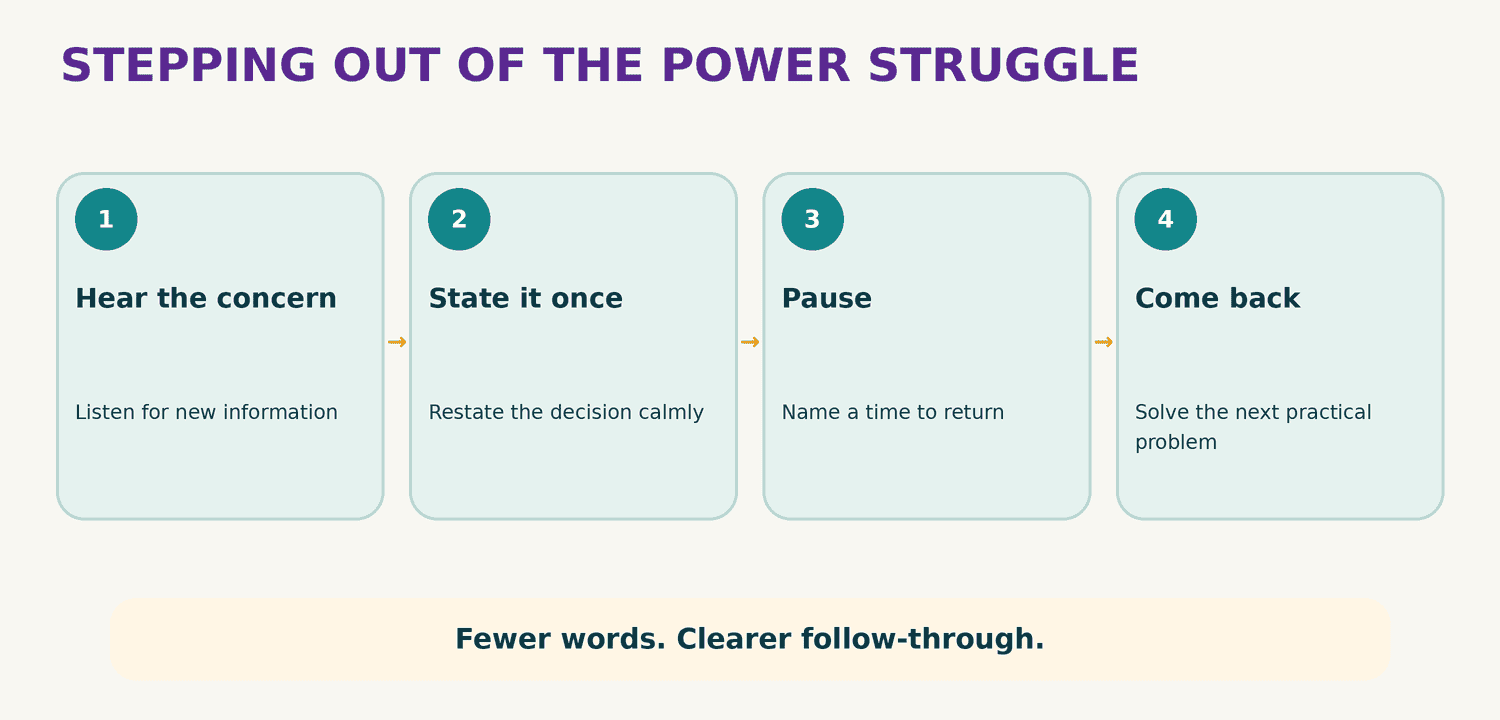
Stepping out of the power struggle: hear the concern, state the decision once, pause with a return time, then come back and solve the next problem.

Keep the Boundary Practical

A break needs to leave everyone clear about what happens next. In this example, the parent still arrives at nine. The parent does not announce three new punishments because the teen protested.

Use an existing, reasonable follow-through plan. If there wasn’t one, avoid improvising a sweeping punishment mid-argument. Work out a clearer arrangement before the next outing.

Disengaging also means checking your own behavior. Are you calling from another room to get the last word? Sending a string of corrective texts? Returning every few minutes to repeat the lecture? Each of those keeps the exchange going.

Worked Examples: Three Common Arguments

These are hypothetical situations. They show one way a parent might respond, not the only right answer.

The Curfew Debate

Sixteen-year-old Jordan wants to stay at a friend’s birthday party until eleven. The family agreement is ten on weekends.

Jordan: “It’s one night. You’re being ridiculous.”

Parent: “I know this party matters to you. Tonight is still ten. If you want to ask about a later time for special events, let’s talk about that tomorrow.”

Jordan: “You never let me do anything.”

Parent: “I hear that it feels that way. I’ll be outside at ten.”

The parent doesn’t argue about the word “never” or list every outing Jordan has been allowed. The next day, the parent asks what a later curfew for special events would need to look like: who is driving, how Jordan will check in, and what happens the next morning. That conversation has a better chance because it isn’t happening at 9:45 p.m.

The Homework Standoff

Fourteen-year-old Priya says she will do her math later. Later has already passed twice this week.

Parent: “We agreed math gets done before screens on school nights. It’s 7:30.”

Priya: “I work better at night. You don’t get it.”

Parent: “That might be true for you. Tonight we’re sticking with the plan. On Saturday, show me how you’d like to schedule it and we’ll look at whether that can work.”

Notice that the parent takes the objection seriously enough to schedule a real discussion. Priya’s preference might turn out to be reasonable. The parent is declining to rewrite the rule in the middle of a standoff, not declining to ever change it.

The “Everyone Else Gets To” Argument

Thirteen-year-old Sam wants a social media account that the family hasn’t approved.

Sam: “Every single person in my grade has it.”

Parent: “Maybe a lot of them do. Our answer is still not yet. I’m willing to hear your reasons on Sunday, and I’ll tell you what I’m worried about too.”

When Sunday comes, the parent listens first, then shares one or two specific concerns instead of a general warning about the internet. The answer may stay the same, but Sam leaves knowing what the concerns are and what might change them.

A Quick Guide for the Moment You Get Pulled In

Use this table to prepare your response before the familiar argument begins. The wording is suggested language to adapt.

What happensYour next moveWords to try
Your teen offers new informationListen and check the facts“That changes what I understood. Tell me about the ride.”
The same objection keeps returningRestate the decision once“I understand you disagree. Pickup is still at nine.”
Your teen attacks your fairnessAcknowledge the feeling, skip the defense“I hear that it feels unfair. The plan for tonight stands.”
Either of you starts getting louderPause and name a return time“We’re getting louder. Let’s talk after breakfast.”
Your teen follows you to keep arguingKeep it brief and create space if safe“I’m done talking about it tonight. Tomorrow at breakfast.”
You return to the discussionSolve the next practical problem“What needs to be different before the next outing?”

How to Handle the Next Conversation

The follow-up conversation is where a power struggle actually changes. If you never return, your teen learns that “we’ll talk later” means “never.” If you return ready to win round two, they learn that the pause was a tactic.

Before You Start

Pick a time when neither of you is rushing, hungry, or about to leave the house. Breakfast on a weekend, a car ride, or a walk often works better than a sit-down meeting. Decide in advance which parts of the rule you are open to discussing and which are fixed. If safety is involved, say so plainly.

Open by Listening

Try: “I said we’d come back to this. What did you want me to understand last night?”

Then let your teen talk without interrupting to correct details. When they finish, summarize what you heard: “So the main problem is that leaving at nine is embarrassing because your friends get picked up later. Is that right?” Summarizing is not agreeing. It shows that the objection was received.

Share Your Reasoning Briefly

Give one or two real reasons, not a full history of every past mistake. “I need you rested for your Saturday shift, and the ride home after ten has been unreliable.” Short reasons are easier to discuss than speeches.

Look for the Practical Problem

Many arguments are about something solvable: transport, timing, embarrassment, or a next-day commitment. Ask: “What would need to be true for a later time to work?” Your teen’s answer gives you something specific to evaluate.

If It Starts Going in Circles Again

Shorten it. “We’re stuck again. Let’s each think about it and talk on Wednesday. Can you find out what time the next event actually ends?” Giving each person a task makes the next attempt more productive than a third round of the same debate.

Close With a Clear Decision

End by stating what was decided, even if the decision is “the current rule stays for now and we’ll review it next month.” If you changed the rule, explain why. “Because there’s a confirmed ride with Alex’s parent, eleven works for this party.” That shows your teen that new information changes decisions, while volume doesn’t.

Frequently Asked Questions

Does Ending the Argument Mean My Teen Wins?

The useful question is whether the expectation stays clear and you follow through. An argument does not have to end with your teen agreeing that you are right.

What If My Teen Says I Never Listen?

Check whether there is some truth in it. Offer a real chance to explain the concern, summarize what you heard, and make clear that listening and saying yes are different things.

What If My Teen Follows Me and Keeps Arguing?

Avoid turning the pause into a chase around the house. Keep your words brief and create space if it is safe to do so. Threats, blocked exits, or physical intimidation call for a safety response, not another boundary script. Seek individualized help for recurring intimidation, and contact local emergency services if anyone is in immediate danger.

One Thing to Try Tonight

Choose one argument that keeps repeating in your home. Write two sentences: the expectation, and when you will revisit it. Practice saying both without adding a lecture.

For another starting point, visit Free Tools and look for “Stop the Fight.” For broader reading, the Extreme Teen book page introduces Parenting Your Out-of-Control Teenager.

By Dr. Scott P. Sells, Ph.D. | Author, Parenting Your Out-of-Control Teenager

Consequences Not Working With Your Teen? What to Reconsider

You’ve grounded your teenager. Taken away the phone. Canceled privileges. And your teen looks you in the eye and says: “I DON’T CARE!”

When consequences don’t work, our instinct is often to make them bigger. But a bigger consequence isn’t necessarily a better one.

Start by checking four things: Is the expectation clear? Does the consequence connect to the behavior? Can you follow through? Does your teen know how to earn the privilege back?

You may need a different tool. Here are four things to reconsider.

1. Stop Making Consequences Bigger

Imagine your teen repeatedly misses curfew. You announce, “You’re grounded for three months!” A few days later, the punishment is almost impossible to maintain, and the bargaining starts.

Try instead: “Our agreement is that you’re home by 10 p.m. If that doesn’t happen, we’ll pause the next optional outing and review the plan.”

Choose consequences that are clear, reasonable, connected to the behavior, realistic to enforce, and explained before the next conflict.

Your teen should know what the rule means in practice. “Be more responsible” leaves room for confusion. “Be home by 10 p.m.” gives both of you something specific to work with.

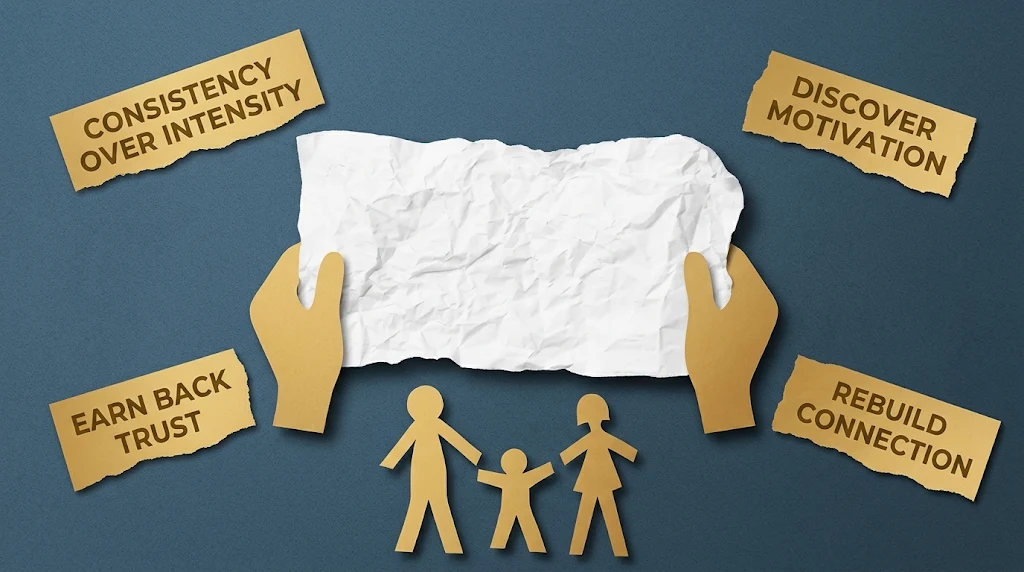
Consistency beats intensity.

2. Discover What Actually Motivates Your Teen

Ask: What matters to my teenager right now? Friends? Independence? Activities? Regaining a privilege?

In Parenting Your Out-of-Control Teenager, I teach parents to identify their teen’s particular motivations rather than assume the same consequence works for everyone. This isn’t about finding something precious to threaten. It’s about linking responsible choices to opportunities for growing independence.

Have the conversation when things are calm. You might ask:

“What is one thing you’d like more freedom to do? Let’s talk about what you would need to show us to handle that responsibility.”

Listen to the answer. A privilege that matters to you may not matter much to your teen.

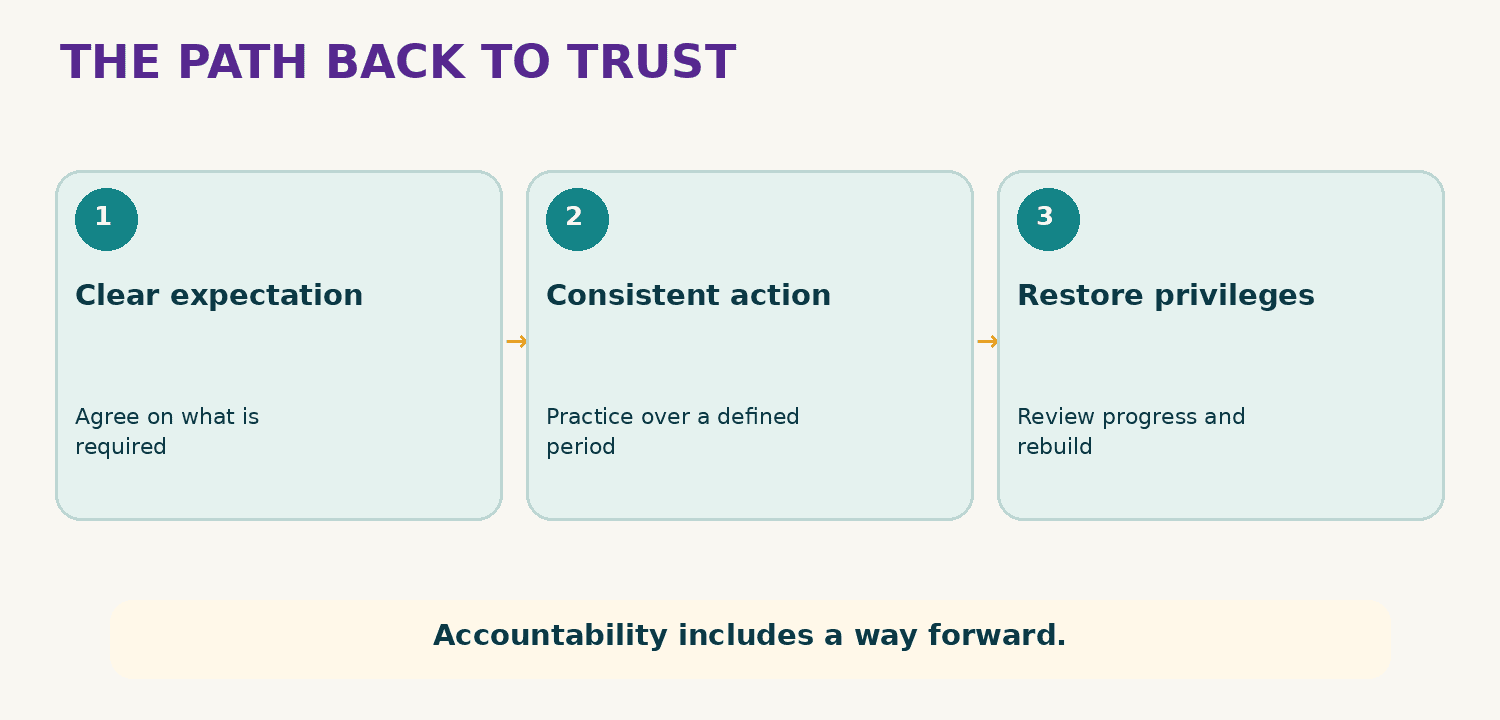
3. Give Your Teen a Way to Earn Trust Back

“You’re grounded until I decide you’ve changed!” leaves no clear finish line. How can your teenager demonstrate progress?

Spell out what needs to happen, when you’ll review it, and what privilege can return. Avoid changing the requirements halfway through.

A Curfew Example: From a Broken Rule to a Clear Plan

Here is an example to adapt to your teen’s age and your family’s situation. It illustrates a plan, not a promise of results.

Expectation: Be home by 10 p.m. If a ride falls through or there’s an unexpected delay, call before curfew so we can make a safe plan.

Consequence: If you miss curfew without an agreed change, the next optional evening outing is paused. We’ll discuss what happened when we’re calm.

Path back: After that pause, the next two optional evening outings will have a 9 p.m. curfew and an agreed ride home. If you meet those expectations, the 10 p.m. curfew returns. We’ll review the plan together the following day.

Your family may need different times or a different arrangement. The point is to make the next step understandable and achievable. A genuine emergency or a delay beyond your teen’s control needs to be considered, too.

Now there’s a clear expectation and a path forward. Accountability should include a pathway back to trust.

4. Rebuild Connection Before the Next Argument

After months of defiance, parents naturally focus on mistakes. But what about the positives?

“I noticed you came home when we agreed today. Thank you. That meant a lot to me.”

No strings attached. No reminder of everything that went wrong last week.

You’re not removing consequences or overlooking serious problems. You’re rebuilding the relationship alongside the rules. Rules WITH a relationship can create better opportunities for cooperation—not perfect cooperation.

Frequently Asked Questions

What If My Teenager Says They Don’t Care About Consequences?

Don’t automatically increase the punishment. Revisit the plan when you’re both calm. Ask what matters to your teen, check whether the expectation is realistic, and make the path back to privileges clear. “I don’t care” does not give you enough information to decide that a harsher consequence is the answer.

What Consequences Work Best for Teenagers?

There is no single consequence that works for every teen. Start with something proportionate to the behavior, practical to enforce, and limited enough that your teen can see a way forward. Explain the plan ahead of time and connect it to the responsibility involved.

What If My Teen Still Refuses to Follow the Plan?

Ask what is getting in the way. Does your teen understand the expectation? Can they carry it out? Do they need help solving a practical problem, such as arranging a ride? Persistent severe defiance, aggression, or safety concerns may need individualized professional support. If anyone is in immediate danger, put safety first and contact local emergency services.

For another professional perspective on proportionate consequences and rebuilding trust, see the Child Mind Institute’s guide to parenting a defiant teen.

One Thing to Try Tonight

Think of your teen’s most common rule violation. Ask: “Does my teen know exactly what I expect—and how to rebuild trust when they get it right?”

If the answer is no, write down one clear expectation, one reasonable consequence, and one way to earn the privilege back. Discuss it when you’re both calm.

Extreme problems require specialized tools—not simply bigger punishments.

For help thinking about what matters to your teen, visit Free Tools and look for “Find Motivation.”

By Dr. Scott P. Sells, Ph.D. | Author, Parenting Your Out-of-Control Teenager

How to Respond to a Disrespectful Teenager Without More Yelling

“No! I’m not doing what you tell me!”

“Take out the trash yourself!”

“I don’t respect you!”

Sound familiar? When your teenager talks this way, it’s natural to get louder, threaten consequences, or launch into a lecture.

If you’re wondering how to deal with a disrespectful teenager, start here: keep your response brief, state the boundary calmly, and return to the problem when you can both talk without escalating. Then follow through. Taking a break does not mean dropping the expectation.

Here’s what I’ve learned in more than 30 years of helping families facing extreme teen behavior: You cannot discipline your way out of disrespect with consequences alone.

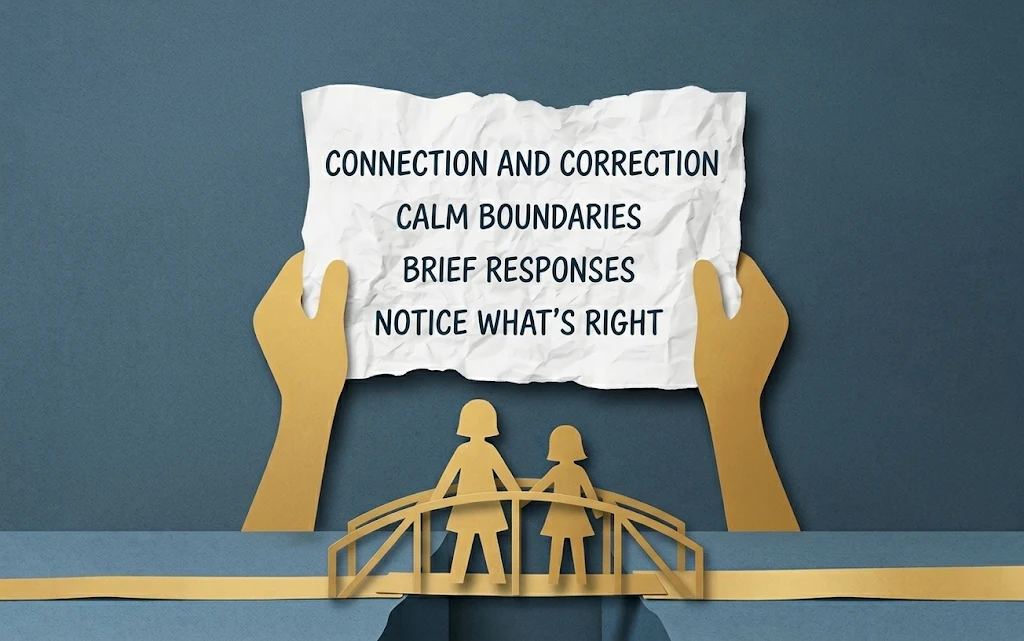
You need connection AND correction. Sometimes the best way to stop the next argument is to change what happens before it begins.

Why Disrespect Keeps Getting Worse

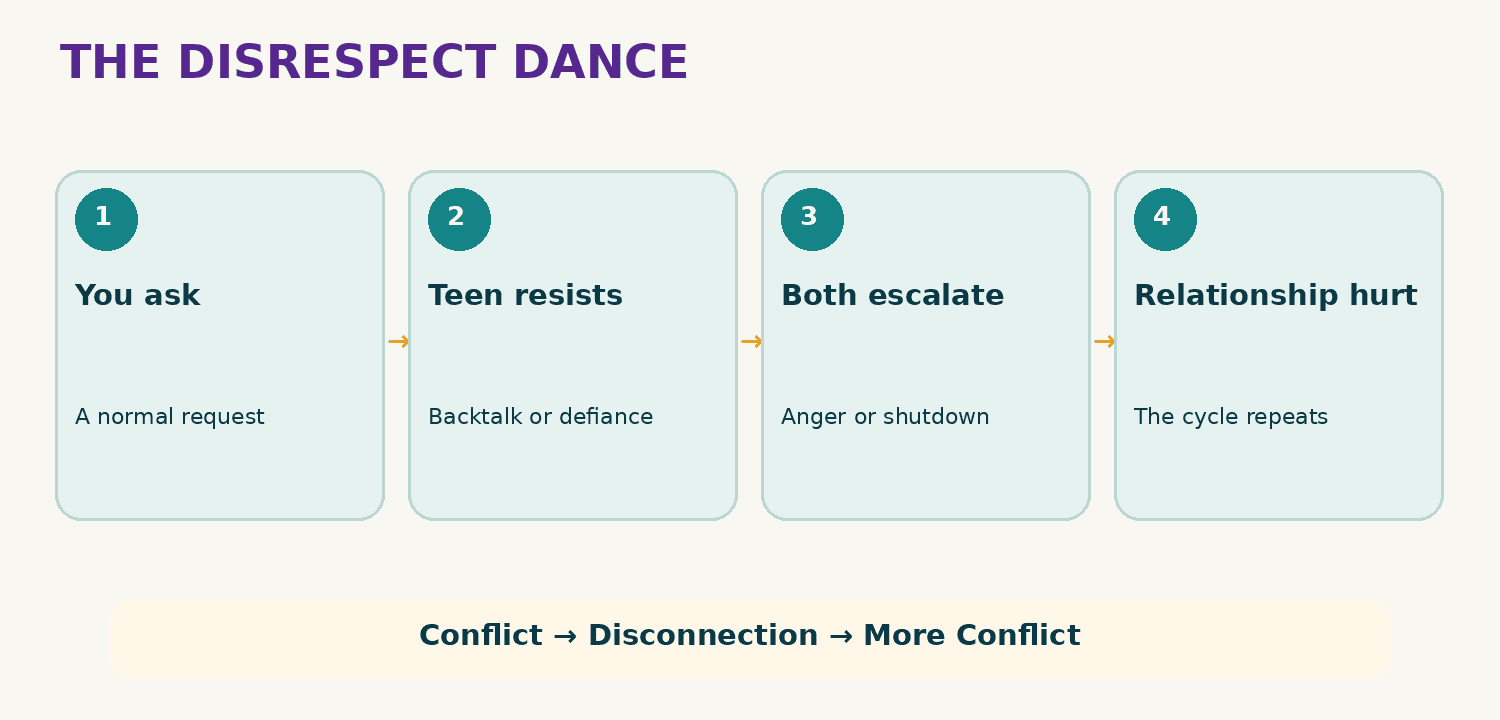
I call it the Disrespect Dance. You make a request. Your teenager resists. You escalate. Your teen escalates. You threaten consequences. Nothing changes—and the relationship takes another hit.

Repeat that dance often enough, and something heartbreaking happens. Parents tell me, “Scott, I love my teenager, but I don’t even like being around them anymore.” The original behavior problem has become a relationship problem, too.

The goal is to change your part in that dance while keeping a clear boundary.

Three Things to Say Instead of Yelling

1. When Your Teen Talks Back

Instead of: “Don’t you dare talk to me like that!”

Try: “I want to hear what you’re saying. But let’s talk when we can both be respectful.”

Keep it brief. You don’t need to answer every insult or convince your teen that you’re right in the middle of the argument.

2. When Your Teen Refuses a Request

Instead of: “You’ll do it NOW, or else!”

Try: “The expectation hasn’t changed. We can talk about it when we’re calmer.”

Then follow through with your established plan. If you haven’t made a clear plan yet, discuss it once everyone is calm rather than announcing a bigger punishment in the heat of the moment.

3. When Your Teen Says Something Hurtful

Instead of: “After everything I’ve done for you!”

Try: “That was hurtful. I’m going to give us some space. We’ll come back to this.”

These aren’t magic words. They help you avoid feeding the conflict while preserving boundaries. Your teen may still be upset. You can keep your own response calm without requiring an immediate apology.

What to Do Once Everyone Is Calm

Come back to the issue. Otherwise, “We’ll talk later” can turn into never talking about it at all.

Name the behavior without labeling your teen. “You called me a name when I asked about the trash” is more specific than “You’re always so disrespectful.”

Listen to what your teen was trying to say. Then explain the expectation for next time. For example:

“You can tell me you’re frustrated. You can ask whether the chore can wait until you finish something. Calling me names isn’t okay. The trash still needs to go out.”

If an agreed consequence applies, follow through calmly. If you yelled, own your part too: “I raised my voice. That wasn’t helpful, and I’m sorry.” You can apologize for yelling and still keep the rule.

Rules WITH a Relationship

Do you still need rules and consequences? Absolutely. Keep clear expectations and appropriate follow-through. Stronger connection may improve the chance of cooperation—not guarantee it. That’s the difference between consequences alone and love with limits.

Start by noticing something your teenager does right. Be specific:

“I noticed you helped your sister today. Thank you.”

Let that stand on its own. Adding “Why can’t you always be like that?” turns a moment of connection into another criticism.

Frequently Asked Questions

Is Disagreement the Same as Disrespect?

No. Teens need room to disagree. “I think that rule is unfair” is different from an insult or a threat. You can hear your teen’s opinion while keeping the boundary.

Should I Ignore Teen Backtalk?

No. Address it briefly and calmly. If the conversation keeps escalating, pause and return to it later. You don’t have to engage in every exchange to make the expectation clear.

How Quickly Will a Calmer Approach Work?

There’s no guaranteed timetable. Focus on consistent boundaries and genuine connection. Look for small changes, such as a shorter argument or a willingness to return to the conversation, rather than expecting instant cooperation.

When Your Family Needs More Support

If conflict is persistent, includes aggression, or disrupts daily family life, seek individualized help from a qualified mental health professional. If anyone is in immediate danger, put safety first and contact local emergency services.

For more on when to seek support, see the Royal Children’s Hospital’s guide to teen behavior.

One Thing to Try Tonight

Notice one positive behavior today. Write it down. Share it without asking for anything back. Sometimes the first step toward less disrespect is remembering there’s still something good between you.

Connection Before Correction.

For a place to start, visit Free Tools and look for “Notice What’s Right.”