By Dr. Scott P. Sells, Ph.D. | Author, Parenting Your Out-of-Control Teenager

“Why?”
“Everyone else is allowed!”
“You haven’t given me a good reason!”
You explain the rule again. Your teen finds another objection. Twenty minutes later, you’re still defending a decision you thought was settled, and neither of you remembers how the conversation started.
If your teenager argues about everything, start by separating a genuine question from repeated bargaining. Hear the concern, state the decision once, and pause when the conversation starts going in circles. Then name a specific time to come back to it. You can stop participating in the argument while keeping the expectation in place.
Notice When the Conversation Starts Repeating
Consider this hypothetical exchange about an evening outing:
Parent: “Tonight’s pickup is at nine.”
Teen: “But everyone is staying until ten!”
Parent: “We already agreed on nine because of tomorrow morning.”
Teen: “You always treat me like a little kid.”
The next response matters. A long defense of every parenting decision pulls both of you away from the actual question, which is what happens tonight.
Listen for new information. Perhaps the event ends later than expected, or the agreed ride fell through. That deserves attention. Repeating the same objection more loudly does not require a new explanation every time.
A useful test: if your teen’s last three sentences could be swapped around without changing their meaning, the conversation has stopped moving. That is your cue to step out.
Use a Short Exit Script
Here is wording to adapt:
“I hear that you want to stay later. Pickup is still at nine tonight. We’re repeating ourselves, so I’m taking a break from this. We can talk tomorrow after breakfast about future outings.”
Keep your delivery ordinary. Sarcasm, a slammed door, or “End of discussion!” can turn an attempt to pause into another challenge.
If your teen keeps bargaining, you can repeat once: “I’ve heard you. We’ll talk about future plans tomorrow.” Then stop adding arguments of your own. Stay available for a practical question or a safety concern.
The Royal Children’s Hospital recommends staying calm and defusing arguments with teens; its teen behavior guidance also explains when additional support may be appropriate.
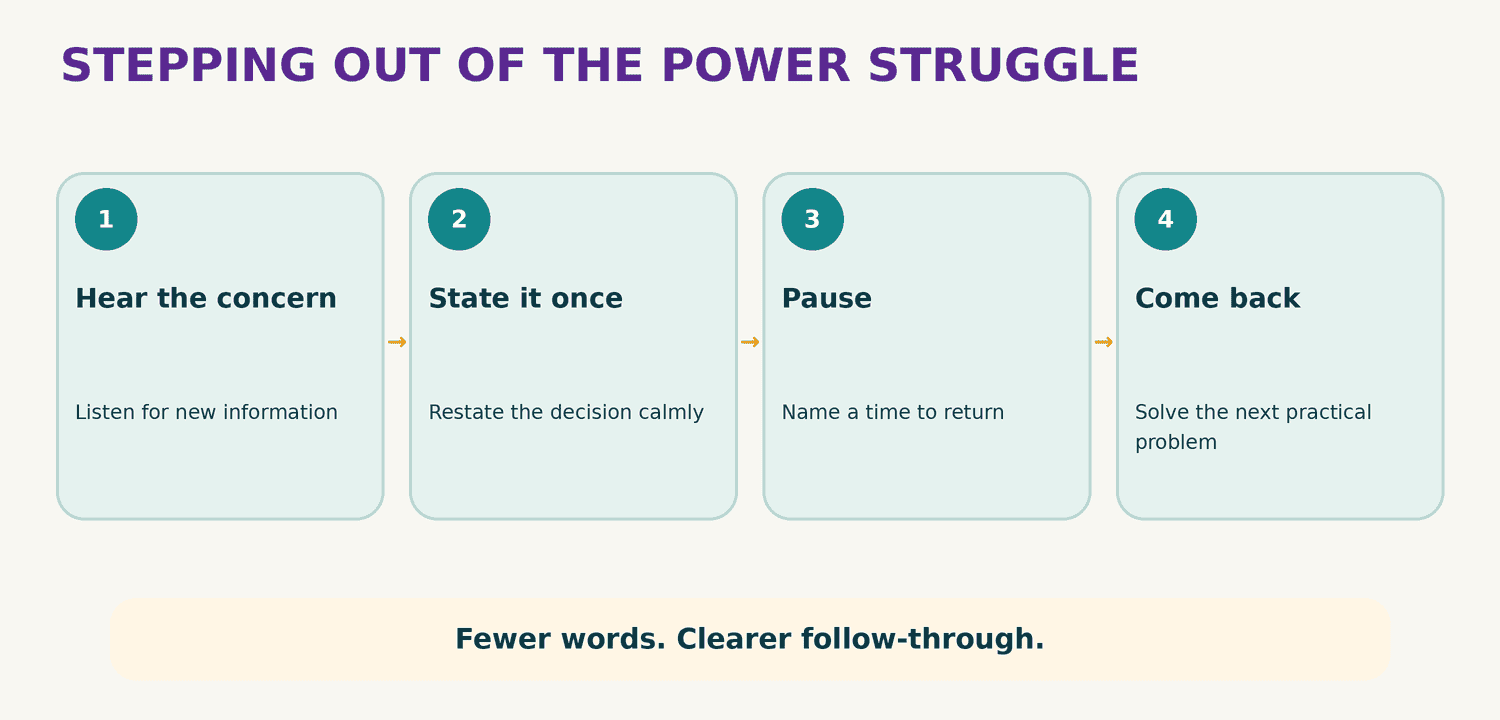
Stepping out of the power struggle: hear the concern, state the decision once, pause with a return time, then come back and solve the next problem.
Keep the Boundary Practical
A break needs to leave everyone clear about what happens next. In this example, the parent still arrives at nine. The parent does not announce three new punishments because the teen protested.
Use an existing, reasonable follow-through plan. If there wasn’t one, avoid improvising a sweeping punishment mid-argument. Work out a clearer arrangement before the next outing.
Disengaging also means checking your own behavior. Are you calling from another room to get the last word? Sending a string of corrective texts? Returning every few minutes to repeat the lecture? Each of those keeps the exchange going.
Worked Examples: Three Common Arguments
These are hypothetical situations. They show one way a parent might respond, not the only right answer.
The Curfew Debate
Sixteen-year-old Jordan wants to stay at a friend’s birthday party until eleven. The family agreement is ten on weekends.
Jordan: “It’s one night. You’re being ridiculous.”
Parent: “I know this party matters to you. Tonight is still ten. If you want to ask about a later time for special events, let’s talk about that tomorrow.”
Jordan: “You never let me do anything.”
Parent: “I hear that it feels that way. I’ll be outside at ten.”
The parent doesn’t argue about the word “never” or list every outing Jordan has been allowed. The next day, the parent asks what a later curfew for special events would need to look like: who is driving, how Jordan will check in, and what happens the next morning. That conversation has a better chance because it isn’t happening at 9:45 p.m.
The Homework Standoff
Fourteen-year-old Priya says she will do her math later. Later has already passed twice this week.
Parent: “We agreed math gets done before screens on school nights. It’s 7:30.”
Priya: “I work better at night. You don’t get it.”
Parent: “That might be true for you. Tonight we’re sticking with the plan. On Saturday, show me how you’d like to schedule it and we’ll look at whether that can work.”
Notice that the parent takes the objection seriously enough to schedule a real discussion. Priya’s preference might turn out to be reasonable. The parent is declining to rewrite the rule in the middle of a standoff, not declining to ever change it.
The “Everyone Else Gets To” Argument
Thirteen-year-old Sam wants a social media account that the family hasn’t approved.
Sam: “Every single person in my grade has it.”
Parent: “Maybe a lot of them do. Our answer is still not yet. I’m willing to hear your reasons on Sunday, and I’ll tell you what I’m worried about too.”
When Sunday comes, the parent listens first, then shares one or two specific concerns instead of a general warning about the internet. The answer may stay the same, but Sam leaves knowing what the concerns are and what might change them.
A Quick Guide for the Moment You Get Pulled In
Use this table to prepare your response before the familiar argument begins. The wording is suggested language to adapt.
| What happens | Your next move | Words to try |
|---|---|---|
| Your teen offers new information | Listen and check the facts | “That changes what I understood. Tell me about the ride.” |
| The same objection keeps returning | Restate the decision once | “I understand you disagree. Pickup is still at nine.” |
| Your teen attacks your fairness | Acknowledge the feeling, skip the defense | “I hear that it feels unfair. The plan for tonight stands.” |
| Either of you starts getting louder | Pause and name a return time | “We’re getting louder. Let’s talk after breakfast.” |
| Your teen follows you to keep arguing | Keep it brief and create space if safe | “I’m done talking about it tonight. Tomorrow at breakfast.” |
| You return to the discussion | Solve the next practical problem | “What needs to be different before the next outing?” |
How to Handle the Next Conversation
The follow-up conversation is where a power struggle actually changes. If you never return, your teen learns that “we’ll talk later” means “never.” If you return ready to win round two, they learn that the pause was a tactic.
Before You Start
Pick a time when neither of you is rushing, hungry, or about to leave the house. Breakfast on a weekend, a car ride, or a walk often works better than a sit-down meeting. Decide in advance which parts of the rule you are open to discussing and which are fixed. If safety is involved, say so plainly.
Open by Listening
Try: “I said we’d come back to this. What did you want me to understand last night?”
Then let your teen talk without interrupting to correct details. When they finish, summarize what you heard: “So the main problem is that leaving at nine is embarrassing because your friends get picked up later. Is that right?” Summarizing is not agreeing. It shows that the objection was received.
Share Your Reasoning Briefly
Give one or two real reasons, not a full history of every past mistake. “I need you rested for your Saturday shift, and the ride home after ten has been unreliable.” Short reasons are easier to discuss than speeches.
Look for the Practical Problem
Many arguments are about something solvable: transport, timing, embarrassment, or a next-day commitment. Ask: “What would need to be true for a later time to work?” Your teen’s answer gives you something specific to evaluate.
If It Starts Going in Circles Again
Shorten it. “We’re stuck again. Let’s each think about it and talk on Wednesday. Can you find out what time the next event actually ends?” Giving each person a task makes the next attempt more productive than a third round of the same debate.
Close With a Clear Decision
End by stating what was decided, even if the decision is “the current rule stays for now and we’ll review it next month.” If you changed the rule, explain why. “Because there’s a confirmed ride with Alex’s parent, eleven works for this party.” That shows your teen that new information changes decisions, while volume doesn’t.
Frequently Asked Questions
Does Ending the Argument Mean My Teen Wins?
The useful question is whether the expectation stays clear and you follow through. An argument does not have to end with your teen agreeing that you are right.
What If My Teen Says I Never Listen?
Check whether there is some truth in it. Offer a real chance to explain the concern, summarize what you heard, and make clear that listening and saying yes are different things.
What If My Teen Follows Me and Keeps Arguing?
Avoid turning the pause into a chase around the house. Keep your words brief and create space if it is safe to do so. Threats, blocked exits, or physical intimidation call for a safety response, not another boundary script. Seek individualized help for recurring intimidation, and contact local emergency services if anyone is in immediate danger.
One Thing to Try Tonight
Choose one argument that keeps repeating in your home. Write two sentences: the expectation, and when you will revisit it. Practice saying both without adding a lecture.
For another starting point, visit Free Tools and look for “Stop the Fight.” For broader reading, the Extreme Teen book page introduces Parenting Your Out-of-Control Teenager.